01 · Dispatch dock
echo-OS: the dispatch dock
Several sessions leave the dock at once, and the long turns are the ones I walk away from. When any Claude Code session on my Mac ends a long turn, echo-OS writes a one- or two-line headline with a small, fast model and reads it aloud, prefixed by the project folder and the session's call sign. Every session gets a NATO call sign for as long as it runs. The project and call sign are added by code, never by the model.
At a glance
- What it is
- macOS menu bar tool
- Announces
- Long Claude Code turns, by voice
- Status
- Open source (MIT)
02 · Assembly line
Lily-Eval: the assembly line
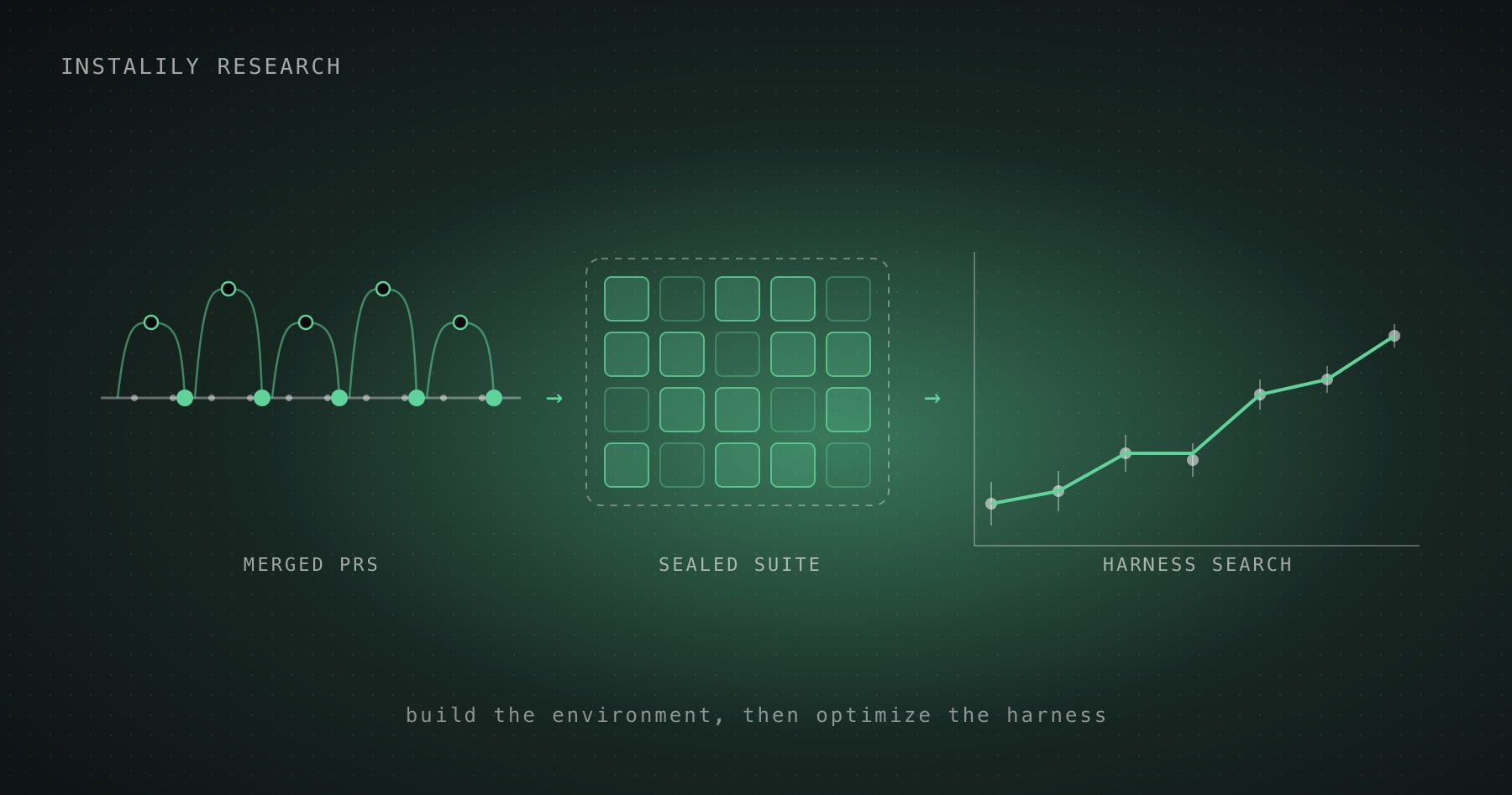
Nothing on this line ships unmeasured. Lily-Eval turns a codebase's merged pull requests into an RL environment. It rewinds the repo to just before each PR, has Lily, InstaLILY's coding agent, reimplement it from the description, and grades the result with deterministic graders and calibrated LLM judges. That grade is the gate on this loop. It became the signal for tuning Lily's harness, and in a 276-trial head-to-head on InstaLILY's own tasks Lily led Claude Code on the deterministic pass bar. The optimizer that climbs the loop was the wider team's work.
At a glance
- Built at
- InstaLILY, summer 2026
- Trials
- 276, Lily vs Claude Code
- Published
- InstaLILY Research, July 2026
03 · Server hall
ego-OS: the server hall
The racks hold my context engine, the heart of my agent stack. ego-OS reads what I already write, builds a graph of my projects, people and priorities, and gives every agent I run a high-fidelity model of me over MCP. Coding agents know past projects and decisions, and planning tracks live priorities. It runs on my own machine, is benchmarked against hand-verified golden sets, and tells an agent when it does not know rather than returning the nearest plausible note.
At a glance
- Runs on
- My own machine
- Serves agents via
- MCP, 32 tools
- Status
- v0.1.0, open source, in daily use
04 · Control room
AgenticNodes: the control room
In the control room the graph is the agent. AgenticNodes is a local graph editor and runtime for agent workflows. Nodes are model calls, tools, data steps and control flow, edges decide what runs next, and you build the graph on a canvas, press run, and watch each step happen live. The graph on this floor is the example bundled with the runtime, a tool-schema repair loop: a model proposes a tool payload, the tool validates it, and a failed validation routes back to a repair step, capped by a repair limit. Every run emits one event stream, which drives the live view, replay, and the per-agent swimlanes on the wall.
At a glance
- What it is
- Local graph editor and runtime
- Runs start from
- A click, cron, a webhook, Discord, Supabase
- Status
- Public repo, development paused
05 · Shipping yard
Outreach CRM: shipping
What ships out of this factory is outreach. Outreach CRM is a spreadsheet-style CRM for students doing networking outreach, and a pipeline their own AI agent can work in. AI drafts each message from what the CRM knows about the sender and the recipient, and a draft may only use facts on file. The student reviews and sends it. The CRM is also an MCP server, so Claude Code, ChatGPT and other agents can work the pipeline alongside them. I run my own job search on it, and Cornell Generative AI runs its outreach from an organization workspace.
At a glance
- MCP tools
- 52
- Rule
- AI drafts, the person sends
- Status
- Open to the public
Stuart Labs
I run like a factory. Agents work the line.
I'm Morgan Stuart. I spend most of my days working out how to leverage coding agents to do the work of ten people. They are my assembly-line workers, and every station on this floor is a project I'm building. Walk the floor or pick a station.
Station 01 · Dispatch dock
echo-OS
Hear when a long Claude Code task finishes, and which session it was.
Read the write-upOne engineer.A floor of agents.Welcome to Stuart Labs.
Stuart Labs is how I work: like a factory. Coding agents are the assembly-line workers, I run the floor, and each station is a project of mine. The output is more than one person used to be able to build, and every project has a write-up of how it works inside.
- 8
- project write-ups
- 52
- MCP tools in Outreach CRM
- 276
- trials, Lily vs Claude Code
- 40+
- engineers in Cornell Generative AI
- 2
- summers at InstaLILY
- 150+
- hours teaching Python
Every station is a project
How the floor runs
I write the spec, agents implement against it, and an eval decides what stays. The pattern repeats across the floor: a clear contract at the boundary most likely to change, a measurement before any tuning, and a written log of why the code looks the way it does.
Enter the labA memory graph for every agent I run
ego-OS turns notes, meetings, email and planning docs into memories, entities and concepts, and serves them to any agent over MCP. Every retrieval change is benchmarked.
Harness changes that have to earn their place
HIVE freezes the model and lets an overseer propose harness edits, kept only when they beat the current best on a graded suite.
A CRM that doubles as an MCP server
Outreach CRM drafts each message from facts on file, the student sends it, and the whole pipeline is available to their own agent through 52 tools.
Notes from the floor
Case studies and essays on building agents, running an evaluation, and leading a student engineering club like a startup.
Questions people ask
What is Stuart Labs?
The name I put on what I build on my own, and the way I build it. I operate like a factory: I run the floor, coding agents work the line, and each station is a project. Most of the projects are infrastructure for agents and are open source where they can be.
What kind of work do you take on?
Agent harnesses, MCP servers, evaluation environments and the tooling for running several agents at once. The write-ups on this site show the level of detail I work at, and how much of each build the agents did.
Are you available?
I graduate from Cornell in May 2027 and want to join an early-stage startup or a small team in New York or San Francisco, working on agents, harnesses, evals or RL environments.